If you are considering a condo investment in Singapore, a practical way to decide is to compare expected capital appreciation, rental growth, and investment track record in the same district. That is exactly the lens behind this Vela Bay Review, focused on District 16 and the specific launch profile of Vela Bay.
District 16 has been attractive because it has delivered both property price momentum and supportive rental demand. But “attractive” is not the same as “good for your goals.” The real question is whether you can buy into the story early enough, with enough fundamentals behind it, to make the numbers work over time.
Embedded Video of Vela Bay Review
Below is a structured analysis of what matters most, what District 16 has shown over 2010 to 2025, and how Vela Bay is positioned within that framework.
Table of Contents
- What Vela Bay Review Really Needs to Answer ✅
- District 16’s Capital Appreciation Story (2010 to 2025) 📈
- How Profitable Have Condo Purchases Been in District 16? 💰
- Rental Growth: Where Investors Often Get Surprised 📊
- Where Vela Bay Fits Into This Narrative 🌊
- Family Demand Signals: Why It Matters Even for Investors 👨👩👧👦
- Project Features That Could Support Future Resale 🏗️
- Connectivity and Lifestyle: The Combination That Often Works 🔑
- So, Should You Buy Vela Bay? A Balanced Checklist 📝
- Practical Investment Tips Before You Commit 🧠
- Where the “First Mover” Idea Can Help and Where It Can Mislead 🚦
- Embedded Video
- Final Take: Vela Bay Review Summary 🎯
- FAQ 🧩
What Vela Bay Review Really Needs to Answer ✅
Before getting swept up by waterfront vibes and connectivity claims, a solid Vela Bay Review should answer three investor questions:
- What capital appreciation is plausible if market sentiment stays constructive?
- How strong is rental demand and what rental levels have been doing?
- Does the project’s location and profile match what tenants and buyers want?
From there, you can decide whether Vela Bay fits an investor’s timeline, risk tolerance, and expected holding period.

District 16’s Capital Appreciation Story (2010 to 2025) 📈
The foundation for any condo investment discussion is capital gains. One way to approximate the future is to look at what has happened recently, then identify whether the drivers are structural or just cyclical.
1) New condo prices rose strongly over five years
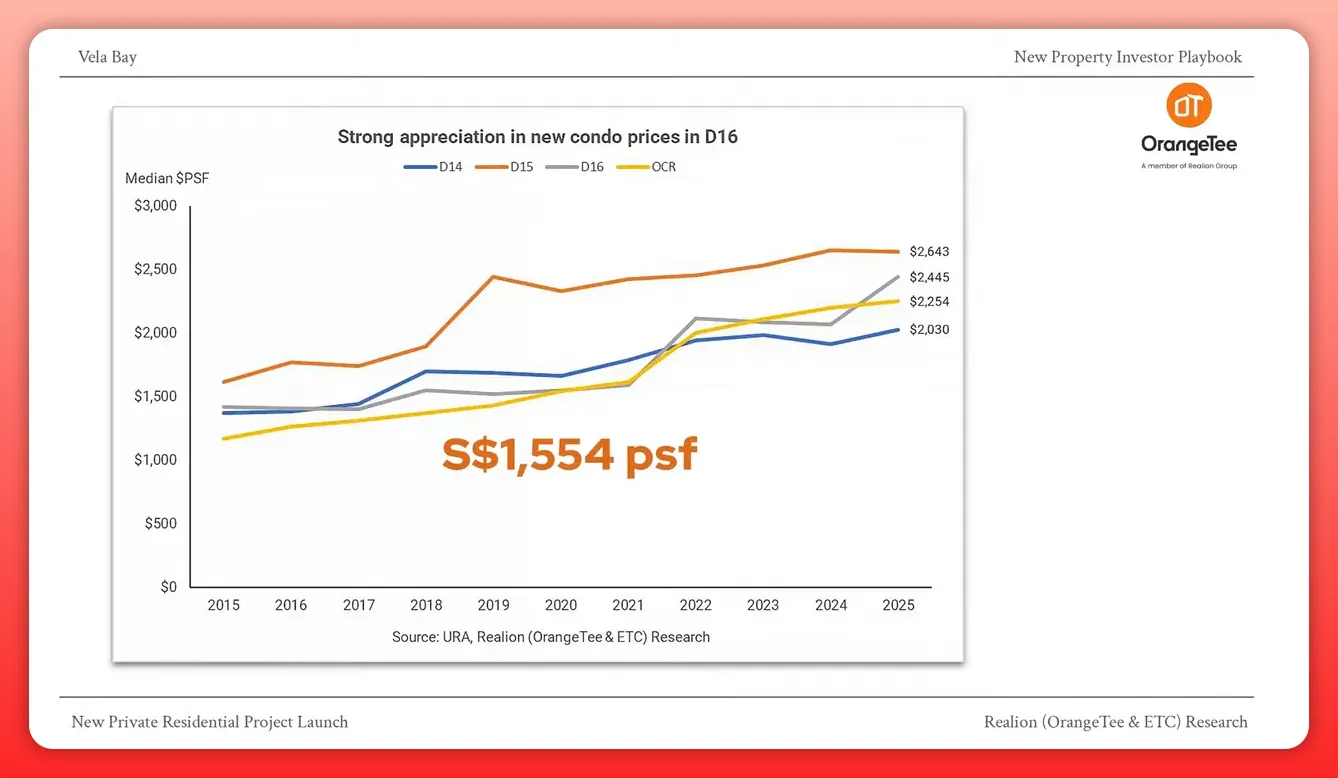
Over the period discussed (2020 to 2025), the price of new condos in District 16 rose by 57.3%, from approximately $1,554 per square foot in 2020 to about $2,445 per square foot in 2025.
This matters because it signals continued buyer confidence for new stock in District 16, not just existing resale units. It also suggests that when supply matures and demand stays steady, the market can reprice upwards rather than stagnate.

2) The performance compared favorably to nearby areas
The analysis highlights that District 16’s five-year increase “avoided” a shorter-horizon value increase seen in nearby areas such as Districts 14 and 15. In plain English: the strongest repricing happened in District 16, at least during this observed window.
For investors, the implication is straightforward. If you buy in a district where the market has shown both demand and willingness to pay for new product, you reduce the chance that appreciation will be purely speculative.

How Profitable Have Condo Purchases Been in District 16? 💰
Capital appreciation is the headline number. But profitability is what investors actually care about. The Vela Bay Review, therefore, looks at transaction outcomes based on URA data from 2010 to 2025, focusing on sales performance and floor resale dynamics.
1) Most transactions ended in profit
Based on the analysis using URA data, 85.3% of transactions related to new and available “dependent” or “floor resale” units in District 16 were profitable across the observed period.
This is a high “profit frequency.” It does not guarantee each individual unit will outperform. Still, it suggests the overall market environment has been supportive for buyers exiting later, rather than being dominated by losses.

2) A large share delivered meaningful gains
The same dataset suggests:
- 40% of profitable units, or 534 condos, showed a “main profit” of at least $200,000.
- 113 units delivered at least $500,000 in profit.
- 12 units achieved at least $1 billion in profits (as stated in the analysis).
Even if individual performance varies by unit size, exact launch pricing, financing costs, and timing, the distribution indicates that there is not just one lucky outlier pattern. There has been a broad ability for many buyers to realize substantial gains.
3) Example: Waterfront Waves as a “most profitable” benchmark
Two concrete examples were highlighted:
- Waterfront Waves: bought for approximately $1.27 million in 2010 and sold back in 2025 for about $2.67 million, resulting in roughly $1.4 million in profit.
- Second highest benchmark: acquired around $997,000 in 2010 and re-sold for about $2.28 million in 2024, yielding about $1.29 million profit.
Benchmarks are never perfect because each project has its own supply timing and buyer profile. However, these examples are useful because they demonstrate how a strong district narrative can compound across years.

Rental Growth: Where Investors Often Get Surprised 📊
Some investors chase capital gains and forget that rental performance influences the “holdability” of a property. If rentals are weak, you may be forced to sell early or carry higher opportunity costs.
District 16 has shown notable rental dynamics in the same period, based on URA data cited in the analysis.

1) Condominium rental growth rose around 50%
The analysis reports an increase in the number of condominium residents of about 50% to a monthly rental level of approximately $3,900 per month between 2020 and 2025.
This signals both demand and pricing power. In practical terms, it indicates that tenants are willing to pay for residential quality and that occupancy has likely remained supported by population growth and limited alternatives.

2) Medical/amenity “rents” are strong too
The analysis further notes that rental growth of specific non-residential segments like “medical development rents” in District 16 differs from broader OCR trends. While the wider OCR saw growth of about 52% over the period, District 16’s “medical rent” reached approximately $3,800 per month in 2025, and was described as higher.
Why does this matter to condo investors? Because strong amenity and employment ecosystems tend to attract both residents and service spending. They also support longer-term local demand that can help rentals stay resilient through cycles.
Where Vela Bay Fits Into This Narrative 🌊
Capital and rental performance are district-level stories. Now let’s connect them to the project-level question: what is Vela Bay positioned to do, and why might that matter for both buyers and future tenants?

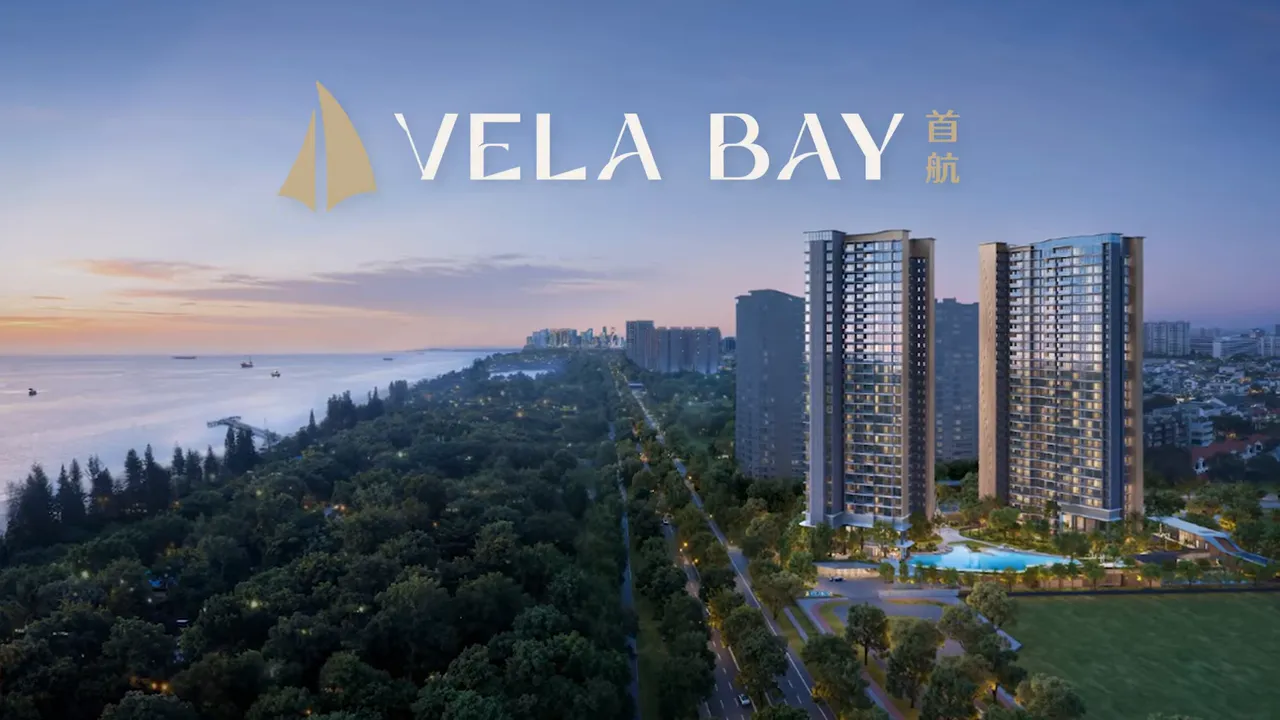
1) A “resort-living” address within Bayshore’s evolving area
Vela Bay (mentioned as “Bella Bay” in the transcript) is described as a living concept resembling resort-style experiences, located within the Bayshore area. The positioning leans heavily on waterfront lifestyle and the idea that District 16 is evolving into a more premium, amenity-rich residential zone.
In a Vela Bay Review, this is less about marketing romance and more about buyer psychology. Waterfront and “resort living” are durable appeal factors in Singapore. They help new condos stand out, which can support both:
- resale desirability when the unit becomes older stock, and
- tenant demand because lifestyle amenities reduce the “swap to cheaper unit” behavior.
2) First-mover premium for an updated waterfront community
The analysis described Vela Bay as a personal “first” waterfront-living project in the area for more than 25 years. For investors, the first mover effect can matter, because when a new district pocket forms, early adopters often benefit from the narrative establishing itself over time.
That does not remove risk, but it can improve the probability of future re-rating if demand catches up to the new identity.
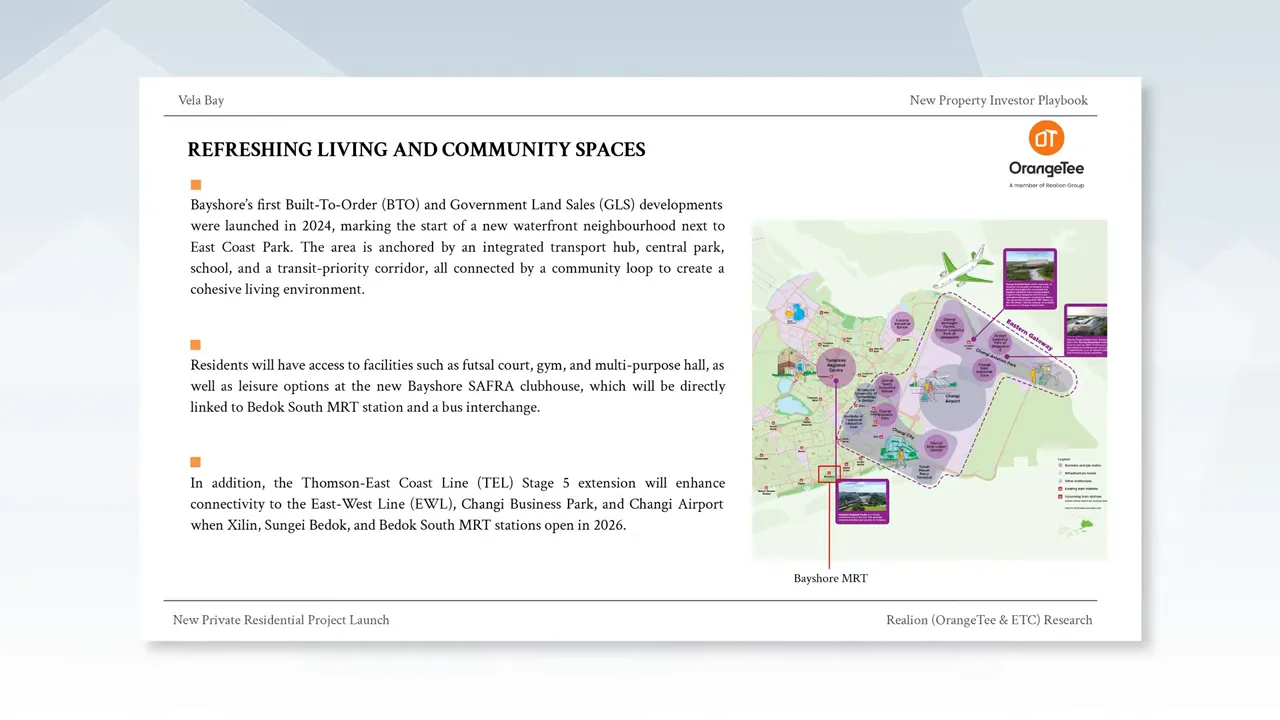
3) Connectivity is positioned as a key value driver
Connectivity claims are common in real estate. What we look for in a Vela Bay Review is whether the claim is specific and aligns with practical commuter behavior.
Here, the pitch emphasizes:
- Bayshore MRT being about one minute away
- approximately 20 minutes travel to CBD, Marina Bay, and Orchard Road (as stated)
If the station is indeed that close, it can increase rental appeal (for both young professionals and relocating families). It also makes it easier for owners to attract end-users rather than only relying on speculative buyers.
Family Demand Signals: Why It Matters Even for Investors 👨👩👧👦
Some investors focus only on yield. But in Singapore, “family-oriented” demand can be a stabilizer for both resale and rental. It is not that families never move. It is that family location preference can create a lasting “why live here” factor.
1) Proximity to a well-regarded school
The pitch highlights that within about 1 kilometer is an “esteemed Temasek primary school” (as stated). Whether you personally need it as a parent, the underlying point is that school proximity supports tenant demand, particularly among established household formation cycles.
2) A range of unit types to fit different buyer profiles
Vela Bay is described as having a variety of layouts, from one-bedroom and study-focused units to a “5-room” type intended for multi-generational families.
From an investment standpoint, a broader unit mix can reduce vacancy risk because you are not restricted to one tenant segment. It can also improve resale options when the market preference shifts.
Project Features That Could Support Future Resale 🏗️
Features do not automatically create value. But they can improve buyer perception, which affects how strongly the market bids for your unit when it is time to sell.
1) 515 exclusive units
The analysis states that Vela Bay has 515 exclusive units. Unit count matters because it influences:
- community density and lifestyle feel
- amenity planning and shared facilities
- resale liquidity and comparable selection when units come back to market
A mid-sized development like this can have a balanced “community” feel without being so massive that the project identity becomes generic.
2) Modern architecture with light and airflow emphasis
The pitch emphasizes architecture inspired by distinctive outlines, and living spaces that “maximize first light” and capture sea breeze flow.
Translated into practical terms, buyers tend to value:
- natural light (brightness and perceived comfort)
- ventilation (freshness and a sense of space)
- layout efficiency (usable space and daily practicality)
3) The “future-ready” delivery narrative: TOP expected in 2030
Vela Bay is described with a TOP expected in 2030. The delivery timeline affects your investment math. For example:
- Longer holding periods increase exposure to market cycles
- But longer periods also allow infrastructure and amenity ecosystems to mature
In a district where the narrative is already strong, a stable development plan can help early buyers experience a smoother “story maturation.”
Connectivity and Lifestyle: The Combination That Often Works 🔑
Many Singapore projects sell one thing well: either location or lifestyle. District 16’s appeal, as framed here, is that it layers both. You get:
- waterfront lifestyle that increases daily satisfaction
- rapid commuting options that increase end-user demand
- education proximity that supports household formation pull
This is why the pitch describes connectivity as the “new advantage.” In real investment terms, connectivity is often what helps rental demand persist when lifestyle appeal alone becomes harder to quantify in price comparisons.

So, Should You Buy Vela Bay? A Balanced Checklist 📝
A Vela Bay Review should not tell everyone to buy. It should help you decide whether the project matches your own investment style. Here’s a checklist built from the key points in the analysis.
Strong “buy interest” signals
- District-level outcomes look supportive: high profitability frequency for prior transactions in District 16 (85.3% profitable cited).
- Capital appreciation has been strong: new condo price growth of 57.3% over 2020 to 2025 cited.
- Rental demand seems to be rising: condominium resident growth around 50% and rental levels reaching about $3,900/month cited.
- Vela Bay appears positioned for lifestyle + connectivity, which can help both rentals and resale desirability.
- The delivery timeline (TOP 2030) may align with ongoing district maturation rather than landing in isolation.

Where you should be cautious
- Timing risk: you are tying value to market conditions between now and 2030, not just the present.
- Unit-specific variance: floor level, orientation, view, layout efficiency, and pricing can change realized returns dramatically.
- Rental isn’t guaranteed: rental demand usually holds better when the unit matches tenant preferences. A mismatch can reduce yield.
If your financial plan can comfortably hold through a market slowdown, Vela Bay’s district narrative may be more compelling. If you are planning to sell quickly, you are more exposed to price volatility.

Practical Investment Tips Before You Commit 🧠
Below are practical steps that turn “interesting investment” into a more disciplined decision.
1) Calculate your scenario, not your hope
Instead of assuming the best-case appreciation, build a range of outcomes based on conservative, base, and optimistic scenarios. Include costs such as:
- legal and stamp duties
- monthly holding costs (where applicable)
- rental vacancy buffer (even if you plan to rent out)

2) Compare Vela Bay to alternatives in District 16
The value of a Vela Bay Review increases when you benchmark the project against other District 16 options. Compare on:
- unit size and layout efficiency
- view quality and orientation
- distance to transit points
- estimated rental demand and tenant profile fit
3) Ask what makes your unit “sellable” later
When TOP approaches, the market will compare your unit to newer launches. Ask:
- Will the layout remain competitive?
- Will the view and lifestyle remain relevant?
- Does your unit have a segment that end-users want (young professional, family, multi-generational)?
Where the “First Mover” Idea Can Help and Where It Can Mislead 🚦
The pitch frames Vela Bay as a first or early premium waterfront living project. This concept can be powerful, but it should be understood correctly.
How first-mover advantage can work
- Early developments define the area identity, attracting early demand.
- Infrastructure and amenities often catch up faster when the first cluster proves demand.
- When supply later expands, the early brand and established community can retain desirability.
How first-mover advantage can disappoint
- If infrastructure delivery slips, the district may not “complete” on schedule.
- If new launches crowd the market, early units might not enjoy the expected premium.
- If market sentiment turns risk-off, buyers delay decisions despite lifestyle appeal.
So, first-mover is an opportunity, not a guarantee. Your underwriting should still be grounded in scenario planning.

Final Take: Vela Bay Review Summary 🎯
This Vela Bay Review takes a straightforward approach: look at District 16’s performance, then evaluate whether Vela Bay’s positioning aligns with the drivers behind those outcomes.
The positive signals from the analysis include:
- New condo prices in District 16 rising 57.3% from 2020 to 2025.
- 85.3% of relevant transactions in the district showing profit across 2010 to 2025.
- A meaningful share of units delivering $200,000+ profit and multiple units reaching $1 million+ in gains (as stated in the analysis).
- Rental demand and rental levels trending upward, including condominium rental pricing around $3,900/month in the cited period.
The project-level fit described for Vela Bay includes resort-style waterfront living, strong connectivity to Bayshore MRT, a family-friendly address near a named primary school, and a development delivery timeline with TOP expected in 2030.
If you are comfortable with the time horizon and can underwrite both capital and rental scenarios, Vela Bay appears to be positioned to benefit from the broader District 16 growth story. If your plan requires near-term liquidity, you should be more cautious because the investment timeline is longer than many traders can tolerate.
FAQ 🧩
Is Vela Bay Review promising only because District 16 prices went up?
District 16’s price growth is a major supportive signal. However, this Vela Bay Review also looks at profitability frequency from past transactions and rental demand indicators in the same district. The intention is to connect Vela Bay’s positioning (connectivity and lifestyle) to the broader demand drivers, not to rely on price movement alone.
What capital growth data was cited for District 16?
The analysis cites new condo price growth of 57.3% over five years, moving from about $1,554 per square foot in 2020 to roughly $2,445 per square foot in 2025.
How often were District 16 condo transactions profitable (2010 to 2025)?
Using URA data as referenced in the analysis, 85.3% of the relevant transactions in District 16 were described as profitable across the period from 2010 to 2025.
Does rental growth in District 16 support an investor holding long term?
The cited analysis reports rental-related momentum, including about 50% condominium resident growth and rental levels reaching around $3,900 per month from 2020 to 2025. This suggests the district has had supportive demand. Still, individual yield depends heavily on unit type and tenant fit.
What is the expected TOP timing for Vela Bay?
The project is described as having an expected T.O.P in 2030 (as stated in the pitch). This affects your underwriting and liquidity timeline.
What makes Vela Bay’s location part of the investment logic?
The analysis emphasizes Bayshore MRT connectivity (about one minute walking) and an approximately 20-minute commute to CBD and key areas. It also highlights family demand factors like proximity to a named Temasek primary school within about 1 kilometer. These factors can support both end-user appeal and rental demand.
Is Vela Bay suitable for both capital gains and rental returns?
Based on the narrative, Vela Bay is positioned for both, because the district has shown capital momentum and supportive rental indicators, while the project’s lifestyle and connectivity aim to maintain desirability. That said, your unit choice and entry price are critical.
Disclaimer: The information provided here is for general guidance only. PropsBit.com.sg does not endorse or guarantee the suitability or accuracy of this information for your specific situation. Although we strive to ensure the content is accurate and reliable at the time of publication, it should not substitute personalised advice from a qualified professional. We strongly recommend not relying solely on this information for financial, investment, property, or legal decisions, and we disclaim any responsibility for decisions made based on this content.
This website’s information is meant solely for general informational use. PropsBit.com.sg and its authors disclaim all liability and responsibility to any individuals or organisations for any outcomes resulting from the use of this website’s content or the information presented here. PropsBit.com.sg reserves the right to add, remove, or change the website’s content at any time without prior notice.