
Last updated: April 30, 2026
As a licensed property agent with OrangeTee & Tie, I spend a lot of time translating official URA statistics into plain language for my clients. Q1 2026 produced some genuinely interesting signals — prices are still rising, but buyer sentiment is cautious. If you are sitting on the fence about buying or selling right now, this breakdown will help you make a more informed decision.
— Jim Tan, Property Agent (OrangeTee & Tie Pte Ltd)
Singapore Private Home Prices Rose in Q1 2026 — But Sales Slowed Down
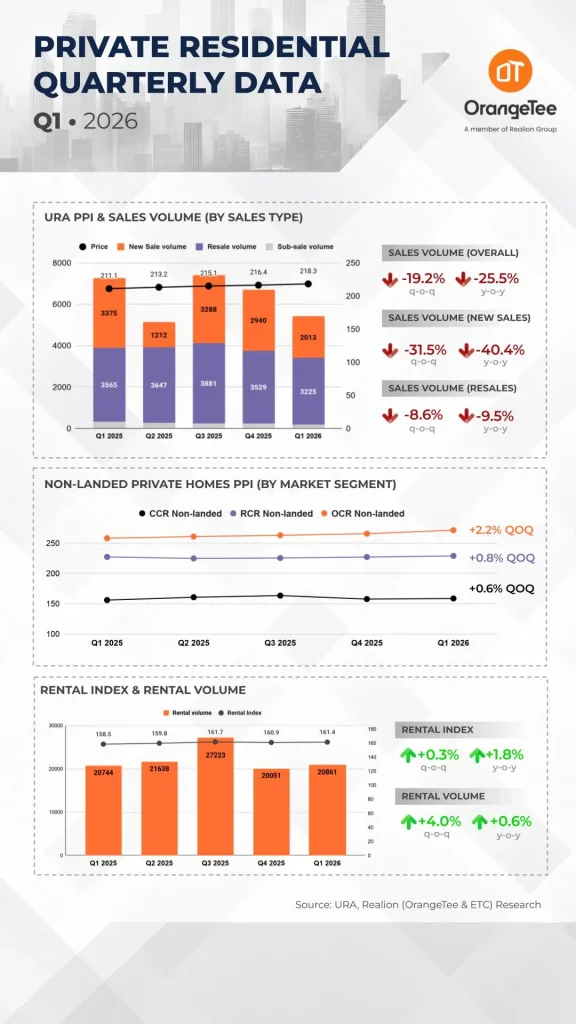
The Urban Redevelopment Authority’s Q1 2026 data tells a story of two halves. On one hand, private residential prices continued rising, with the overall price index up 0.9% quarter-on-quarter. On the other hand, transaction volumes fell for the second consecutive quarter, with private home sales (excluding ECs) dropping to 5,413 units — the lowest quarterly resale volume in two years.
What does this mean in plain terms? The market is not crashing. Prices are still holding up. But fewer people are pulling the trigger, and that matters for anyone planning to buy or sell in 2026.
Why Did Sales Drop So Sharply?
New sales saw the biggest drop — down 31.5% quarter-on-quarter. But before you panic, there is a straightforward explanation: fewer projects launched during the Chinese New Year period. Launched uncompleted units fell from 2,632 in Q4 2025 to just 1,844 in Q1 2026, a 29.9% decline.
This is a supply timing issue, not a demand collapse. Q2 2026 is expected to be significantly stronger, with major launches like Vela Bay — the first private home launch in the new Bayshore precinct — and Tengah Garden Residences, the first private residential development in the new Tengah estate. Both are likely to see strong first-weekend sales as buyers look to ride the first-mover advantage in brand new precincts.


What Is Driving Buyer Caution Right Now?
From my conversations with clients, I can identify three main reasons buyers are holding back:
The first is interest rate uncertainty. Fixed mortgage rates have begun inching upward at some banks, making monthly repayment calculations less predictable than they were 12 months ago.
The second is global economic noise. US tariff tensions, Middle East geopolitical risks, and MNC hiring slowdowns are making some buyers — particularly those whose income is tied to multinational employers — more cautious about committing to large purchases.
The third is affordability calibration. After several years of price increases, some buyers are genuinely waiting to see if prices plateau or correct before entering. The data suggests prices are not correcting — but the wait-and-see sentiment is real.
Which Segments Are Still Performing Well?
Not all segments are slowing down equally. According to the OrangeTee & Tie Realion research team, these segments are bucking the trend:
New homes in attractive locations continue to sell strongly. Rivelle@Tampines and Pinery Residences both sold more than 90% of their units within the first weekend of launch — a clear sign that well-located, well-priced new launches still command strong demand.
Executive Condominiums remain highly attractive due to their more accessible price points and the subsidy eligibility for eligible buyers.
The luxury segment is also holding firm, as ultra-high-net-worth buyers are less sensitive to mortgage rate fluctuations and more focused on Singapore’s long-term political stability and wealth-preservation credentials.
Singapore Rental Market — A Modest Recovery
After a 0.5% drop in Q4 2025, private residential rents rebounded by 0.3% in Q1 2026. This is a modest recovery, driven largely by tenants returning to the market after the year-end holidays.
However, the rental outlook for 2026 is cautiously positive rather than bullish. The OrangeTee & Tie research team projects private rents to grow 2–3% for the full year, with approximately 82,000 to 87,000 leases expected.
The main risk to rentals is corporate hiring slowdowns. Some MNCs have reduced cross-border employment and international placements, which affects expatriate demand for premium rental properties. On the positive side, incoming talent from the AI sector is expected to partially offset this pressure.
For landlords, my practical advice is to be realistic on pricing in 2026. The days of 10–15% annual rental increases are behind us. A well-maintained unit priced at market rate will lease — an overpriced unit will sit vacant.
My Price Outlook for 2026
Based on the OrangeTee & Tie Realion research and my own ground-level experience, I expect private residential prices to grow 2.5–4.5% for the full year 2026, with 23,500 to 25,500 total transactions.
This is a moderated but healthy market. Not the frenzied pace of 2021–2022, but not a correction either. For buyers, this environment actually offers something rare — time to make considered decisions without the fear of missing out that dominated the post-COVID market.
For sellers, the window is still positive but requires realistic pricing. Overpriced listings are sitting longer in 2026 than they did two years ago.
What This Means for HDB Upgraders Specifically
If you are an HDB owner considering upgrading to a private property in 2026, the current environment is actually more favourable than it looks on the surface:
HDB resale prices have been rising for 21 consecutive quarters, meaning your existing flat has likely appreciated significantly in value. Your proceeds from the sale of your HDB flat may be stronger than you expect.
Private home prices are rising more slowly than in 2021–2023, giving upgraders a better entry point relative to the peak.
The key question is your mortgage affordability under current interest rates. This is the first conversation I have with every upgrader client — before we look at a single listing.
If you would like a personalised assessment of your upgrading options based on your current flat value and income, feel free to reach out directly.
Singapore Property Market Q1 2026 — FAQ
Q: Did Singapore property prices fall in Q1 2026? No. Private residential prices rose 0.9% quarter-on-quarter in Q1 2026, according to URA data. While sales volumes dipped, prices continued their upward trend.
Q: Why did private home sales drop in Q1 2026? The main reason was fewer new project launches during the Chinese New Year period. New sales fell 31.5% quarter-on-quarter, primarily due to a 29.9% decline in units launched. This is a seasonal supply issue rather than a demand collapse.
Q: What is the Singapore property price outlook for 2026? OrangeTee & Tie Realion projects private residential prices to grow 2.5–4.5% for the full year 2026, with 23,500 to 25,500 total transactions expected.
Q: Are Singapore rentals going up or down in 2026? Private rents rebounded 0.3% in Q1 2026 after a dip in Q4 2025. Overall private rents are projected to grow 2–3% for the full year 2026, with approximately 82,000 to 87,000 leases expected.
Q: Is now a good time to buy private property in Singapore? The current market offers buyers more time to make considered decisions compared to the frenzied 2021–2022 period. Prices are rising but at a moderated pace. The key factors for individual buyers are mortgage affordability under current interest rates, the value of any existing HDB flat, and their timeline. Consulting a licensed agent for a personalised assessment is recommended before making any decision.
Q: What are the best new property launches coming in Q2 2026? Two major launches to watch are Vela Bay — the first private home launch in the new Bayshore precinct — and Tengah Garden Residences, the first private residential development in the Tengah estate. Both are expected to attract strong first-weekend demand from buyers seeking first-mover advantage in new precincts.
Source: URA Q1 2026 Real Estate Statistics | OrangeTee & Tie Realion Research & Analytics | Published April 2026
Disclaimer: This article is for informational purposes only and does not constitute financial or investment advice. Consult a licensed property professional for advice specific to your situation.